

L4-L5 Herniation: Interlaminar Endoscopic Technique
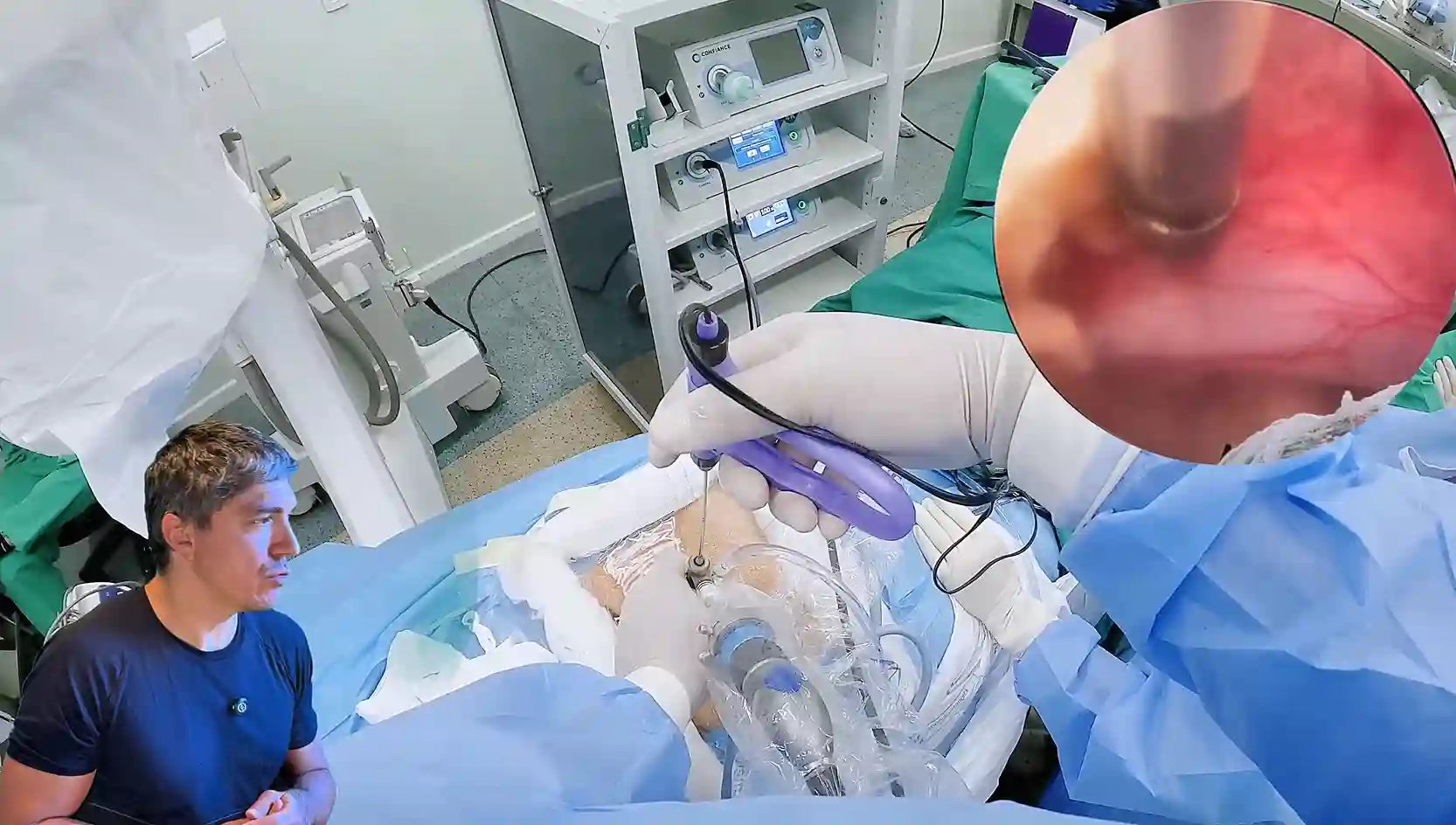
This educational case reviews an endoscopic interlaminar approach to a left-sided L4-L5 lumbar disc herniation with caudal migration. The narration emphasizes anatomical orientation, safe exposure of the interlaminar window, identification of key bony landmarks, soft-tissue management, hemostasis, and the rationale for progressive bone work during access to the disc level.
The case highlights the stepwise exposure of the L4 lamina, L5 lamina, facet junction, ligamentum flavum, and medial and lateral limits of the interlaminar window. Particular attention is given to the use of endoscopic instruments such as the Love forceps, bipolar radiofrequency device, endoscopic scissors, dissector, and drill. The discussion also addresses decision-making around burr selection, including the transition from a cutting burr to a diamond burr as the surgeon approaches the inner cortical bone and ligamentum flavum.
The content is intended for medical education and procedural analysis in neurosurgery and spine surgery. It does not replace supervised training, institutional protocols, imaging review, or individualized clinical judgment.
INCLUDED CONTENT
- De-identified procedural case narration
- Endoscopic view orientation and landmark identification
- Stepwise exposure of the interlaminar window
- Discussion of soft-tissue dissection and hemostasis
- Instrument-use commentary including Love forceps, bipolar radiofrequency, dissector, scissors, and drill
- Bone work strategy at the L4-L5 interlaminar region
- Safety-focused procedural reasoning
- Anatomical discussion relevant to lumbar endoscopic spine surgery
TARGET AUDIENCE
- Neurosurgery residents and fellows
- Spine surgery fellows
- Neurosurgeons developing familiarity with endoscopic lumbar techniques
- Orthopedic spine surgeons interested in endoscopic interlaminar approaches
- Medical educators involved in procedural spine training
- Operating room professionals seeking anatomy-focused procedural context
EDUCATIONAL NOTICE
This content is for medical and surgical education only. It is based on a de-identified procedural case and does not provide patient-specific medical advice, clinical outcome guarantees, or a substitute for supervised training. All procedural content should be reviewed by qualified medical professionals and interpreted in accordance with institutional protocols, current evidence, and individual clinical judgment.
حدِّد الخيارات
L4-L5 Herniation: Interlaminar Endoscopic Technique

HD Surgical Videos
High-quality procedure-based training.