
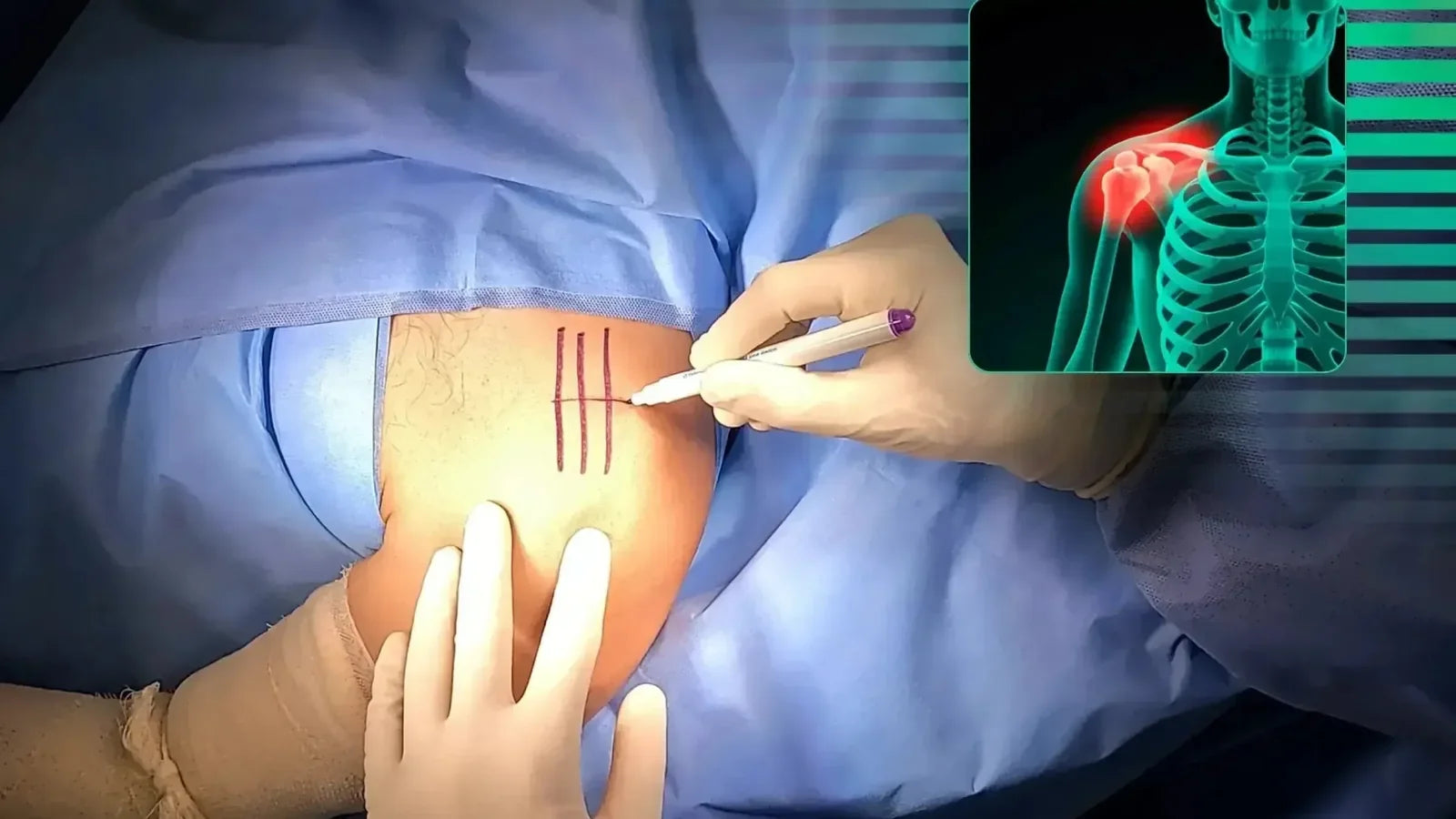
The camera angle in a surgical video is not merely a production decision.
It determines what the learner can see, how the operative field is interpreted and whether the relationship between vision, instruments and movement can be understood.
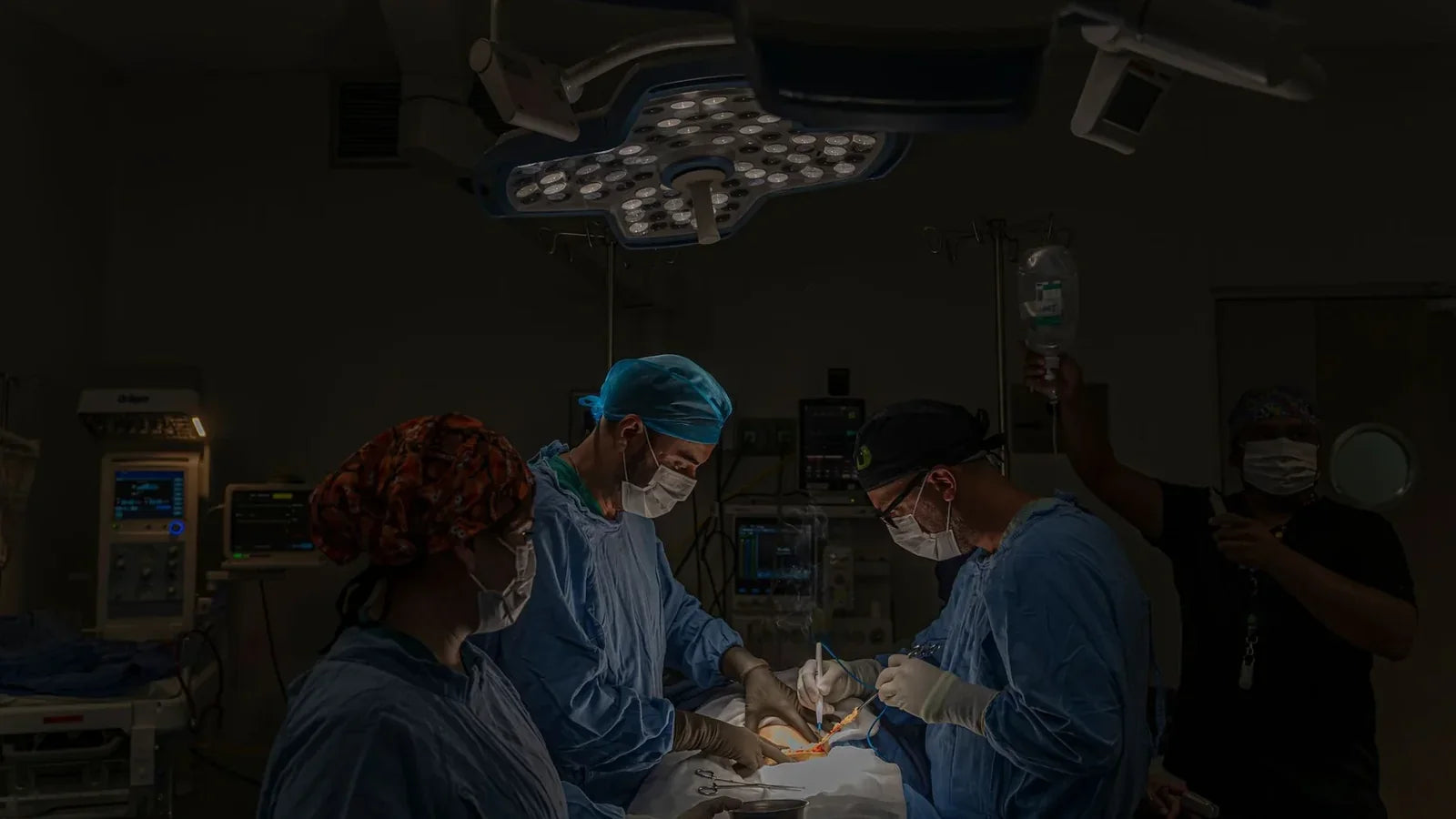
Traditional surgical video usually shows the operation from outside. The viewer sees the surgeon, the assistants and part of the operative field.
Surgeon point-of-view video changes the perspective.
Instead of only watching the operator, the learner is brought closer to the visual field from which the operation is actually performed.
External surgical video and surgeon POV are not the same
An external camera is useful for documenting the operating room, team positioning and general procedural context.
It may not consistently show:
- the surgeon's exact line of sight;
- anatomical depth;
- subtle tissue planes;
- instrument entry angles;
- hand positioning;
- traction vectors;
- the spatial relationship between both hands;
- the next visual target.
The surgeon's head and hands may also block the external camera at the precise moment when the most important step occurs.
A properly positioned POV camera follows the operator's visual orientation.
When the surgeon looks toward an anatomical landmark, the camera moves with that visual field. When instrument direction changes, the viewer can observe the movement from a perspective closer to the one guiding the action.
The learner is not simply watching someone perform surgery.
The learner is studying the operation from the operator's point of view.
Surgical expertise combines perception and action
Surgery is not only a sequence of memorized steps.
During an operation, the surgeon repeatedly moves through a cognitive-motor cycle:
- identify a visual target;
- interpret its anatomical or technical significance;
- choose an action;
- determine an instrument trajectory;
- execute the movement;
- observe the result;
- adjust the next movement.
These decisions occur continuously.
A surgical video becomes more educational when it helps the learner understand this relationship between seeing, interpreting, deciding and moving.
POV is particularly relevant because it can expose the visual-motor logic of the operator, not only the final result of a surgical maneuver.
Why expert narration matters
A clear image can show what happened.
Narration can explain why it happened.
During a procedure, an experienced surgeon makes numerous decisions that may not be obvious from the video alone:
- why a specific approach was selected;
- which anatomical landmark guides the next step;
- why traction is applied in a particular direction;
- when the operative plan should change;
- which structure is at risk;
- how an instrument should be angled;
- what common error should be avoided;
- which alternative technique could be used.
Without narration, much of this reasoning remains inside the surgeon's mind.
Expert-guided explanation converts tacit operative knowledge into information that can be studied.
The learner can simultaneously observe what the surgeon sees, what the surgeon does and why the surgeon makes each decision.
The SNIPER Method
The Surgie educational model incorporates the principles of the SNIPER Method, developed by Dr. Sávio Chami.
SNIPER stands for:
Surgical Narrative & Immersive Perspective with Enhanced Recording
The methodology combines:
- first-person surgical visualization;
- structured technical narration;
- real operative procedures;
- pedagogical editing;
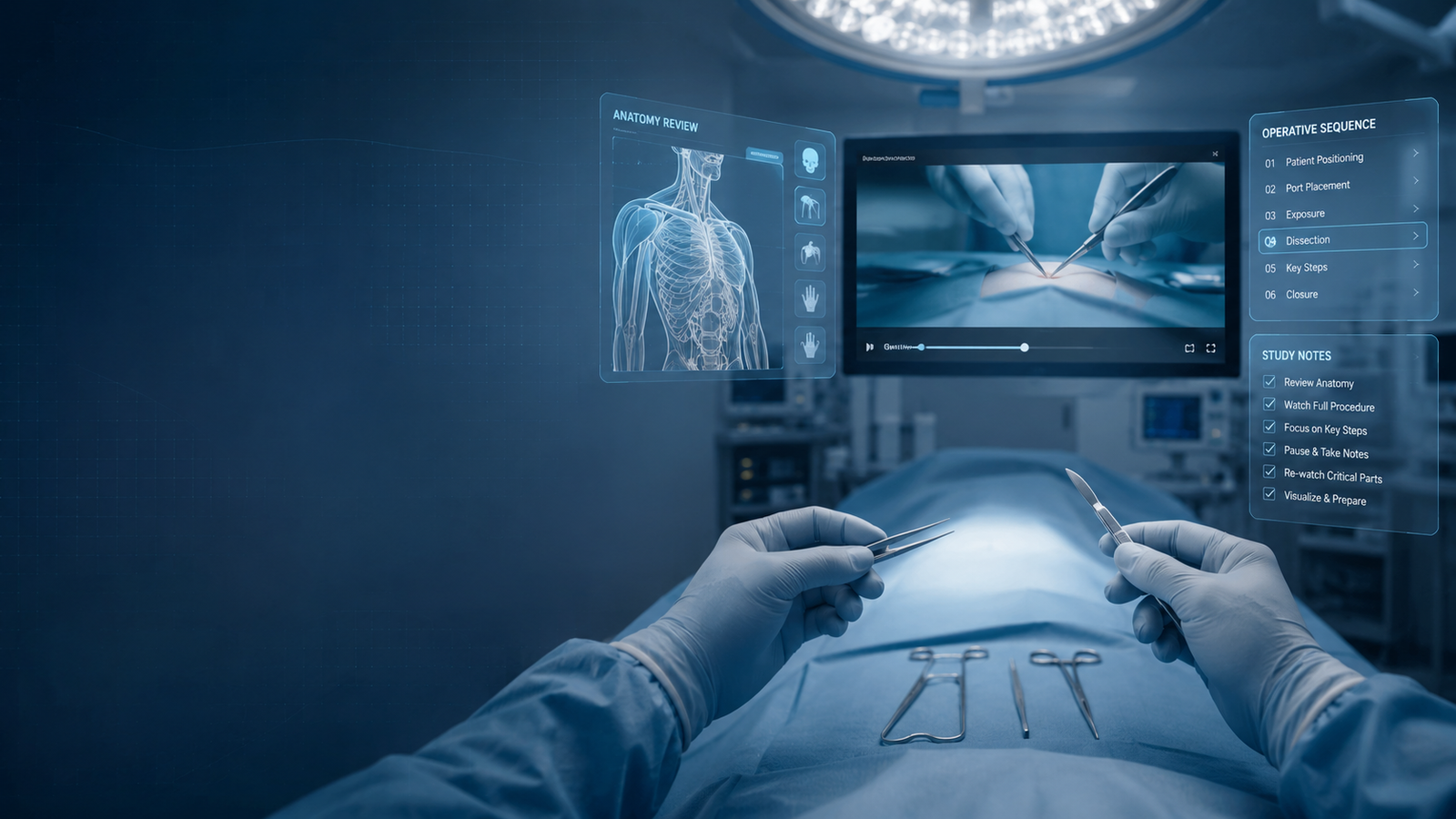
- anatomical and visual overlays;
- repeated access to the procedure;
- cognitive rehearsal;
- preparation for supervised practice.
The objective is not simply to create a larger library of surgical videos.
The objective is to transform recorded procedures into structured educational experiences that can be observed, understood, repeated and reviewed.
From raw surgical footage to structured learning
A complete operative recording contains clinically important moments, but it also contains waiting periods, equipment adjustments, repetitive actions and visual interruptions.
Educational production requires more than recording.
A structured surgical video should provide a coherent progression:
1. Clinical context
The learner should understand the case, indication and relevant diagnostic information before the technical procedure begins.
2. Operative planning
Patient positioning, surgical approach, anatomical references, implants and essential equipment should be identified.
3. Step-by-step execution
Each relevant phase of the operation should be organized in a logical sequence.
4. Decision points
The surgeon should explain why a particular strategy was selected and when an alternative could be considered.
5. Pearls and risks
Critical structures, preventable errors and important technical details should be highlighted.
6. Conclusion
The learner should see the immediate result and review the principal educational points.
The combination of medical curation, POV recording, expert narration and pedagogical editing differentiates structured surgical education from unedited operative footage.
Repetition supports preparation
One of the strongest advantages of digital surgical education is repeatability.
A learner can watch the complete procedure, return to a difficult step, pause at an anatomical landmark or compare multiple approaches to the same condition.
The same operation can be studied:
- before participating in a supervised case;
- after assisting in a procedure;
- when reviewing an unfamiliar technique;
- when comparing another surgeon's approach;
- while preparing a teaching discussion;
- when reinforcing a procedural sequence.
Every review can have a different objective.
The first viewing may focus on overall flow.
The second may focus on anatomy.
The third may focus on hand coordination and instrument direction.
The fourth may focus on decisions, risks and alternatives.
This process supports the construction of a more detailed mental representation of the procedure. It does not replace clinical experience, but it can improve preparation for each supervised opportunity.
How Surgie applies this model
Surgie is built around real procedures shared by experienced physicians across orthopedics, spine surgery, implant dentistry, critical care and other growing specialties.
The platform allows physicians to explore content by procedure, specialty, expert and channel.
Its current access model includes:
- complete free procedures;
- no account required to begin watching free content;
- previews of up to 50% for selected paid procedures;
- surgeon-led technical explanations;
- multilingual audio and subtitles on supported content;
- saved procedures and additional resources through a free account.
These elements allow the learner to evaluate the educational value of a case before deciding whether to unlock full access.
Preparation, not substitution
Surgeon POV is a powerful educational perspective, but a video does not make someone independently competent to perform a procedure.
Surgical learning requires:
- formal medical education;
- anatomical knowledge;
- clinical judgment;
- qualified mentorship;
- supervised progression;
- simulation or cadaveric training when appropriate;
- institutional protocols;
- direct operative experience;
- professional credentialing.
Surgie and the SNIPER Method are designed to support this pathway.
They make expert surgical perspectives repeatable and accessible beyond the physical limits of one operating room.
The purpose is not to remove supervision from surgical education.
The purpose is to make supervised opportunities more productive by improving preparation before the learner enters the operating room.
From watching surgery to studying surgical expertise
Traditional video documents what happened.
Structured surgeon POV education can help explain:
- what the surgeon saw;
- where attention was directed;
- how instruments were positioned;
- why a decision was made;
- which sequence was followed;
- what risks were anticipated;
- how perception and movement were connected.
That is the transition from watching a surgical procedure to studying surgical expertise.
See what the surgeon sees.
Understand what the surgeon thinks.
Repeat until the sequence becomes familiar.
Arrive at supervised practice better prepared.
Watch a free procedure and experience surgeon-led surgical education on Surgie.
Educational notice: Surgie content is intended for qualified healthcare professionals. It does not replace professional judgment, formal training, credentialing, institutional protocols or appropriately supervised clinical experience.

Leave a comment
This site is protected by hCaptcha and the hCaptcha Privacy Policy and Terms of Service apply.